
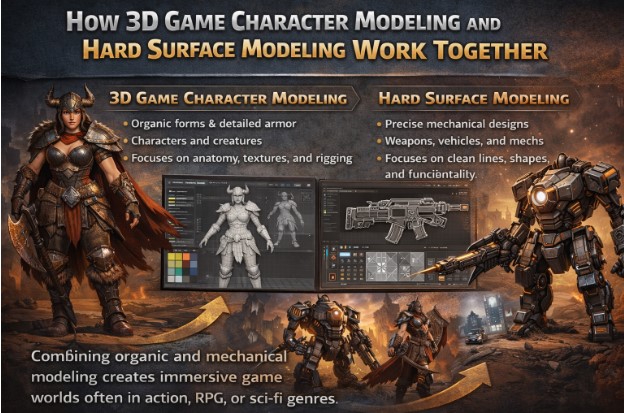
The modern video game character is much more complex than a simple human mesh. From armored warriors to science fiction robots and hybrids, today’s characters are a combination of natural models and precision-crafted machines.
This is where 3D game character modeling and hard surface models become combined as two different areas being responsible for the character design, animation, and simulations in real-time video game environments.
Instead of being handled as distinct workflows in the past, these two modeling techniques are now completely integrated in contemporary production pipelines, focusing on the AAA and indie games.
Comprehending Two Approaches to Modeling
Before delving deeper into their relationship, it is essential to identify what each field concentrates on.
3D Game Character Modeling (Organic Modeling)
The field is centered around:
- Anatomy and proportions
- Facial features and expressions
- Facial expressions
- Skin, Muscle, and Cloth Modeling
- Natural deformation for animation
Organic character modeling is a crucial aspect when it comes to animations, as it enables the character to move, express emotions, and connect with the player in an organic manner.
Hard Surface Modeling
Hard Surface Modeling involves modeling non-organic hard surfaces, like:
- Armor, Helmets, and Weapons
- Mechanical Limbs and Exoskeletons
- Sci-fi suits, gadgets, and accessories
- Robots and vehicles with characters
Hard-surface assets tend to focus on detail, sharply angled edges, and smooth topology instead of organic curves.
In contemporary games, a character generally needs both.
Why Modern Game Characters Require a Combination of Disciplines
Few game characters are only biologically based anymore. Even fantasy game characters are likely to wear composite armor, have advanced weapons systems, or have cybernetic implants. Sci-fi games are more dependent than ever on this mix of elements.
Through the fusion of character modeling in 3D game technology and hard surface modeling, studios are capable of:
- Create visually rich and believable characters
- Realistic anatomy
- Realistic equipment
- Complex game mechanics can be supported
- Create movie-like visuals with high-performance capabilities
Today, the blending of these fields has become the norm in the gaming industry.
How the Two Workflows Interact with Each Other
1. Integrated Concept and Design Stage
Integration starts in concept art. “It’s all about design,” says character concept artist EdCanadian. “We try to balance all these elements: the look of the character, the costume design, and all the props that we need to integrate into this world.
To ensure that minimal revisions take place in the future, early planning is best.
2. Organic Base First, Hard Surface Second
In most pipelines, the artists begin with the organic character:
- Modeling Anatomy and Proportions
- Establishing Pose and Silhouette
After this process is finished, hard components are added above it. Doing this ensures that weapons, armor, or equipment do not work counter to their own anatomy.
For instance, shoulder armor plating must take into consideration the rotation of the arm; otherwise, chest plates would behave unrealistically when a character moves their torso.
3. Separate Modeling, Unified Retopology
The organic and hard surface model parts are generally modeled individually but optimized simultaneously in the retopology process.
This guarantees:
- Clean deformation loops for organic regions
- Optimization of polygon tiling in rigid particles
- Connection between soft and hard regions
A good topology is all the more important at the interfaces where organic and mechanical parts meet each other in places like joints, belts, or exoskeleton joints.
4. Shared UV and Texture
In modern character models, texture sets may be shared across organic and hard surface elements in order to gain performance benefits like:
- Using PBR Workflows.
- Heavy armor also utilizes sharp normal and reflective properties
- Fabric and leather are between these two
Thus, this single texturing technique ensures both image consistency and engine compatibility.
Gameplay and Gameplay Customizations – Advantages
A major aspect of the interaction between organic and hard surface modeling is that it serves a purpose beyond what the eye can see, because it affects gameplay.
Modern games depend on:
- Increases health points and
- Weapons swaps
- Cosmetic Customization
- Damage states and modular gear
Having hard assets modeled in detail and integrated into their character pipeline gives developers ease in being able to:
- Swap armor without rebuilding the character
- Players should be provided with an option for personalization.
Enable Progression Systems Visually
This flexibility is one of the reasons why studios are investing heavily in combined workflows for modeling.
Performance Tuning for Real-Time Engines
Visual aesthetic and speed must be balanced. Optimum convergence of two modeling techniques can be a delicate task.
Best practices are:
- How to use Normal maps instead of the detail geometry for hard edges.
- Reducing the number of draw calls by using material atlases
- Building LODs for organic and hard surface models
Those studios that get the right balance will provide characters of a high level of detail that perform well on all platforms.
Outsourcing and the Production of Hybrid Characters
Since this is a workflow that is dependent on a number of specialized skills, most studios end up outsourcing certain aspects of this process to 3D game art outsourcing services.
Outsourcing partners may:
- Focus specializations include: Hard Surface gear and weapons
- Deliver optimized, engine-ready assets
- Comply with strict topology and performance requirements
- Large character set production at scale
This enables the in-house teams to work on the core design features while ensuring a uniform quality of assets.
Consistency Across Large Game Worlds
Large games involve dozens or hundreds of characters, who must have a common visual language.
The integration of both organic and hard surface modeling in a pipeline guarantees that:
- The details of the character
- Unified scale and proportions
- A cohesive art style across factions/classes
Having this consistency is critical for immersion, particularly in open-world and live service games.
Conclusion
In current game production, 3D character model creation and hard surface modeling are no longer distinct areas of expertise but two halves of the same process of art and technology. While organic modelers focus on adding life, emotion, and motion to a character or model, hard surface modelers focus on adding function and complexity to it.
With both platforms, characters can be designed that offer a good balance between aesthetically pleasing features and those essential for animation and real-time gaming. In-house game development and 3D game art outsourcing companies can take advantage of such a holistic and integrated approach to create characters for games.
Given the ever-increasing expectations of players, the smooth integration between these two modeling fields will continue to be an essential characteristic in the construction of next-generation game worlds.